BREW
Documenting the Reality of Brewing: Letting the Medium Speak
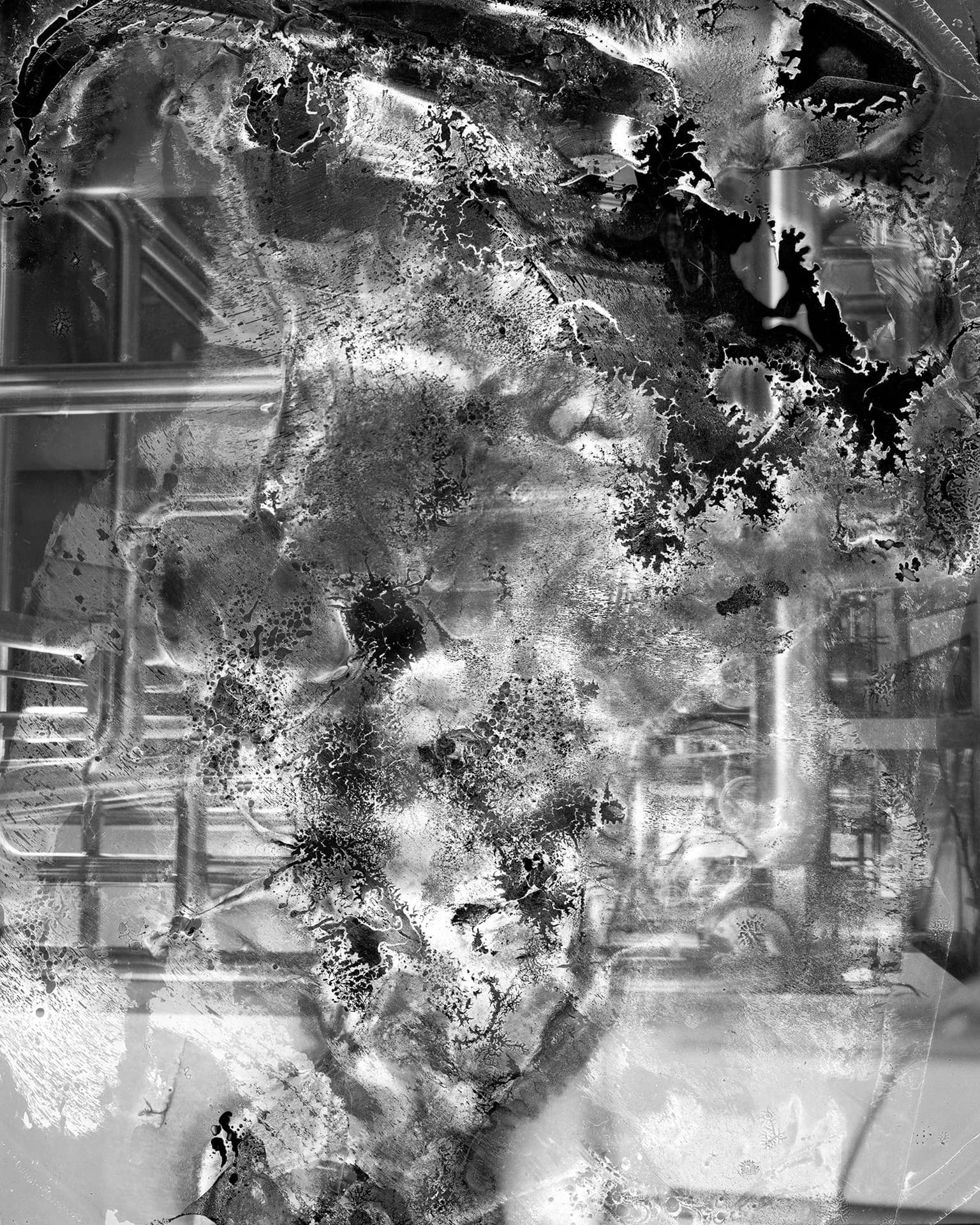
While photographing inside the brewhouse facilities, my aim is not only to document the visual reality of this production space, but to conduct an experiment in which the very product of these halls—beer—directly and physically alters the image itself.
By submerging film in beer, I allow external elements to damage the emulsion, causing it to peel, dissolve, and transform. The results are unpredictable: strange patterns emerge, reminiscent of children’s scribbles, abstract expressionist paintings, microscopic images of tissue, leaf veins, or even tectonic fractures.
.webp)
In Buddhist philosophy, reality is composed of many layers, most of which are inaccessible to our undeveloped perception and intellect. So too in art—the true artist learns from nature and from within, whereas mere talent often follows established paradigms, becoming a copier rather than a creator. As Arnold Schoenberg once said, we grow up with ideals and hold false notions about everything—rarely do we have the courage to approach phenomena in a way that transforms them into moments of exception.
.webp)
Philosopher Vilém Flusser wrote that the photographer becomes a prisoner of technology, enslaved by the “program” encoded within the camera's black box. The true task of the artist is to break free from this program—to go beyond it. This opens up an infinite field of possibility, one that includes what’s often called the “aesthetics of error.” Many photographers, both amateur and professional, after mastering the intricacies of analog processes, seem to deliberately relinquish control. They surrender to chance, treating the behavior of chemicals—emulsions, developers, and beyond—as a kind of providence. Some immerse their film in seawater to form salt crystals on the surface; others distort their negatives after developing.
.webp)
This reflects a deeper contrast between Western and Eastern philosophies of creation, as described by Alan Watts. In Zen, there is no duality or conflict between the natural element of chance and the human element of control. Western artistic forms arose from a spiritual tradition that separates spirit from nature, where the mind descends to dominate inert matter—hence Malraux’s idea of the artist as someone who “conquers” their material. For Chinese or Japanese sensibilities, this sounds absurd. When climbing a mountain, it is not only your legs that lift you—but the mountain itself. When painting, the result depends not just on your hand, but equally on the brush, the ink, and the paper.
.webp)
And so we arrive at the idea of artistic asceticism—a surrender of ego. Here, the artist steps back to allow chaotic natural forces to leave their mark, to affirm that the environment—not the author—is the determining force in contemporary art.
.webp)